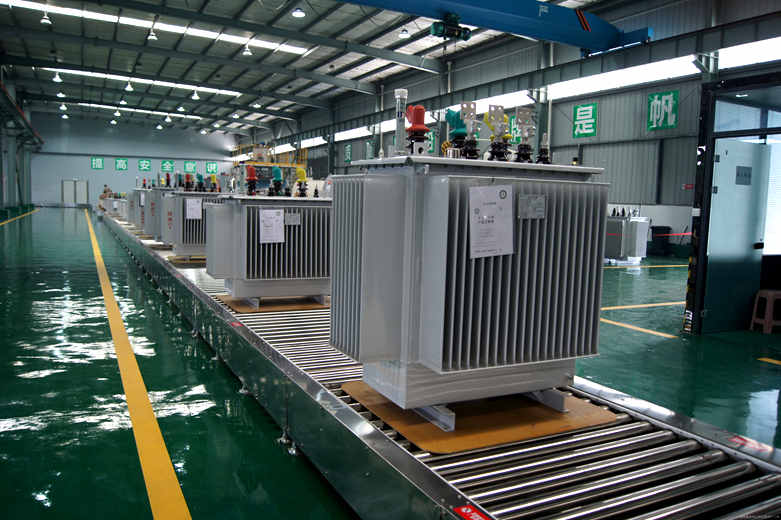
This transformer assembly line is a dedicated transformer production line for three-dimensional wound-core oil-immersed distribution transformers. It covers the full workflow including core processing, winding assembly, active part assembly, tank final assembly and finished product testing. It mass-produces S13, S20 and S22 series 10kV three-dimensional wound-core oil-immersed distribution transformers, serving as a manufacturing line for fully-sealed corrugated-tank oil-immersed distribution transformers. The units placed on the roller conveyor in the picture are finished oil-immersed transformers after tank assembly and accessory installation. The entire transformer production line connects all process stations via a heavy-duty roller conveying system. Workpieces move sequentially along the transformer assembly line to reduce collision damage during handling of heavy transformer units, stabilize process consistency and support large-scale mass production in factories. It is a professional power transformer manufacturing pipeline.
The three-dimensional wound core is the core magnetic component of this series of low no-load loss distribution transformers. The front-end stations of the transformer production line adopt continuous winding technology with grain-oriented silicon steel strips to fabricate triangular 3D closed core frames. Compared with conventional stacked cores, the three-dimensional wound core features a continuous, joint-free magnetic path with lower magnetic reluctance. It significantly reduces no-load loss and no-load current and delivers superior energy-saving performance, which represents the core technical feature of energy-efficient distribution transformers. The formed cores are transported by the transformer assembly line to the winding assembly station for high- and low-voltage coil fitting to form semi-finished transformer active parts.
During winding assembly, high-voltage and low-voltage windings are wound and fitted onto the three-dimensional wound core. Insulation paper is adopted as the main insulation for windings, which are externally secured with fiberglass tape to restrain winding deformation and prevent coil displacement during transfer. This structure does not use epoxy resin encapsulation and represents a typical active part structure of oil-immersed transformers. After active part assembly, the components go through vacuum drying to remove moisture inside insulating materials. They are then placed into corrugated metal tanks, followed by vacuum pumping and filling with transformer oil. Transformer oil functions both as insulation and heat dissipation medium. The corrugated radiators on the outer tank wall perform heat exchange, which can be seen on the side of finished transformers in the photo and serves as the signature structure of corrugated-tank oil transformers.
Stations of the entire transformer production line are arranged in process sequence, with separated zones for silicon steel cutting, core winding, coil winding, active part assembly, tank assembly and finished product testing. As the core transfer carrier of the transformer assembly line, the roller conveyor sequentially transports raw core blanks, semi-finished active parts and fully assembled complete units to realize continuous process connection and form a complete distribution transformer final assembly line. The workshop is equipped with epoxy flooring to meet cleanliness requirements for power equipment manufacturing. It prevents dust deposition on cores and windings and avoids partial discharge risks after transformers are put into operation. Overhead cranes are installed in the workshop for hoisting heavy tanks and active parts to meet assembly requirements for large transformer components.
Three-dimensional wound-core oil-immersed distribution transformers manufactured by this transformer production line have a rated voltage of 10kV. They are widely used in urban power distribution networks, industrial plants, photovoltaic power stations and residential power distribution systems to step down 10kV high voltage to 380V low voltage for end consumption. Compared with conventional stacked-core oil-immersed transformers, three-dimensional wound-core transformers feature lower operating noise and higher material utilization, suitable for grid energy-saving renovation and new energy supporting projects.
This transformer assembly line manufactures oil-immersed transformers, whose process differs from that of dry-type transformer production lines. Windings of dry-type transformers are fully encapsulated by cast epoxy resin without transformer oil. In contrast, products from this transformer production line rely on paper insulation plus transformer oil for insulation and heat dissipation and are equipped with sealed tanks. Three-dimensional wound core structures can be designed for both oil-immersed and dry-type transformers. However, the equipment configuration and process flow of this transformer assembly line are developed specifically for oil-immersed transformers.
For production quality control, the transformer production line incorporates multiple in-process inspection points. Magnetic performance is tested after core fabrication; insulation resistance and DC resistance are measured after winding fitting; insulation performance is retested after active part drying. Once complete unit assembly is finished, full set of factory acceptance tests for distribution transformers are carried out at the end of the transformer assembly line. Finished units on the roller conveyor in the photo can only be packed and delivered after passing factory inspection. The full transformer assembly line supports flexible production, enabling switchover to manufacture three-dimensional wound-core oil-immersed transformers of different capacities to meet multi-variety order requirements.
Previous: circuit breaker assembly...
Next: No more results